
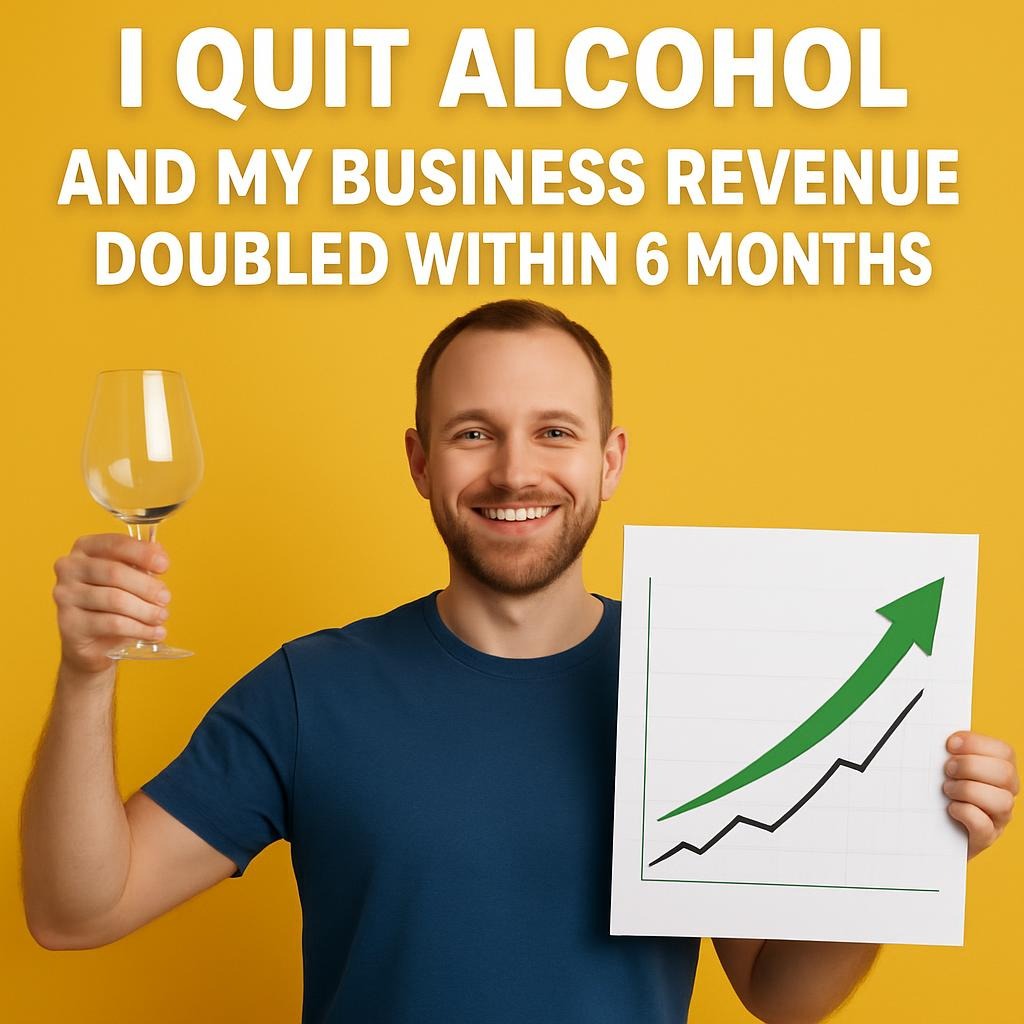
Discover how eliminating alcohol transformed an entrepreneur’s business performance, cognitive clarity, and decision-making abilities, leading to doubled revenue in just 6 months through improved focus and strategic thinking.
The room was spinning, but not from alcohol this time. I was staring at my laptop screen at 2:47 AM, watching the numbers that would change everything. My business revenue had officially doubled. Six months earlier, I’d made a decision that every entrepreneur in my network thought was career suicide: I quit drinking entirely.
The transformation didn’t happen overnight, but the results speak for themselves. What started as a personal health decision became the most profitable business strategy I’d ever implemented. While my competitors were nursing hangovers and making clouded decisions, I was operating with a clarity that felt almost unfair.
This isn’t another sobriety success story wrapped in feel-good platitudes. This is about the hard business reality of what happens when you remove the one substance that’s been quietly sabotaging your entrepreneurial potential. The cognitive revolution that follows alcohol elimination creates a competitive advantage so profound that it feels like accessing a cheat code for business success.
The Cognitive Clarity Revolution
The first thing that struck me wasn’t the absence of hangovers, though that was certainly welcome. It was the sheer mental bandwidth that suddenly became available. Imagine your brain as a high-performance computer that’s been running dozens of background processes you didn’t even know about. Alcohol elimination is like closing all those unnecessary programs and watching your system performance skyrocket.
Within the first month, I noticed my ability to hold complex business concepts in my mind simultaneously had expanded dramatically. Strategic planning sessions that once felt overwhelming became manageable, even energizing. The mental fog that I’d attributed to “just getting older” or “entrepreneurial stress” lifted entirely, revealing a cognitive capacity I’d forgotten I possessed.
This enhanced mental clarity manifested in practical ways almost immediately. Contract negotiations became sharper as I could process multiple variables without losing track of key details. Financial projections that once required multiple review sessions could be completed with confidence in a single sitting. The ability to see connections between seemingly unrelated business opportunities became almost intuitive.
The compound effect of this cognitive enhancement cannot be overstated. Every business decision, from minor operational choices to major strategic pivots, benefited from this newfound mental acuity. While the cumulative impact took months to fully materialize in revenue figures, the daily improvements in decision-making quality were immediate and measurable.
Decision-Making Without the Haze
Entrepreneurs face thousands of micro-decisions daily, each carrying potential consequences for business trajectory. What I discovered was that alcohol, even in moderate amounts, was creating a subtle but persistent interference pattern in my decision-making process. Not enough to cause obvious problems, but sufficient to consistently nudge me toward suboptimal choices.
The change in decision-making quality became apparent during my first major business pivot after quitting alcohol. A partnership opportunity arose that required careful evaluation of market conditions, competitive landscape, and resource allocation. Pre-sobriety, I would have approached this decision with what I now recognize as compromised analytical abilities, likely leading to either paralysis or rushed judgment.
Instead, I found myself able to process information with remarkable efficiency and confidence. The anxiety that typically accompanied major business decisions had transformed into focused anticipation. Risk assessment became more nuanced, allowing me to identify opportunities that my previous mindset would have dismissed as too uncertain.
This enhanced decision-making capability created a virtuous cycle. Better decisions led to improved outcomes, which built confidence, which enabled even bolder and more strategic choices. The cumulative effect was a business trajectory that felt both more ambitious and more achievable than ever before.
The speed of decision-making also improved dramatically. Opportunities that might have lingered in my consideration for weeks were evaluated and acted upon within days. In entrepreneurship, timing often determines success or failure, and this acceleration in decision-making became a significant competitive advantage.
Energy Levels and Sustained Performance
The energy transformation was perhaps the most immediately noticeable change. What I had accepted as normal energy fluctuations throughout the day were actually the result of alcohol’s impact on sleep quality and metabolic function. Removing alcohol didn’t just eliminate hangovers; it fundamentally altered my energy baseline.
Morning productivity, which had always been my strongest suit, extended well into the afternoon without the typical 3 PM crash. This sustained energy allowed for longer periods of deep work, essential for tackling complex business challenges that require extended focus. Projects that once required multiple sessions due to mental fatigue could be completed in single, concentrated efforts.
The quality of rest improved dramatically, creating a positive feedback loop of enhanced performance. Better sleep led to improved cognitive function, which enabled more effective work sessions, which reduced stress levels, which further improved sleep quality. This cycle became self-reinforcing, creating a foundation of sustained high performance that alcohol had been systematically undermining.
Physical stamina also increased significantly, enabling longer workdays when necessary without the diminishing returns that had previously made extended work sessions counterproductive. The ability to maintain peak performance for extended periods became particularly valuable during critical business phases like product launches or major negotiations.
This enhanced energy wasn’t just about working more hours; it was about working with greater intensity and focus during those hours. The result was a dramatic improvement in productivity per hour worked, effectively multiplying the impact of time invested in business activities.
Networking and Relationship Building Transformation
Business relationships form the backbone of entrepreneurial success, and alcohol elimination revolutionized my approach to networking and relationship building. The social anxiety that had driven me to rely on alcohol as a networking lubricant was replaced by authentic confidence and genuine interest in others.
Professional events became opportunities for meaningful connection rather than exercises in social endurance. Without the crutch of alcohol, I developed more sophisticated social skills and deeper listening abilities. Conversations became more substantive, leading to stronger professional relationships and more valuable business connections.
The authenticity that emerged from sober networking created a competitive advantage in building trust with potential partners, clients, and investors. People responded positively to the genuine presence and clear communication that sobriety enabled. Business relationships developed more quickly and with greater depth than ever before.
Morning meetings, which had occasionally been challenging due to previous evening’s consumption, became consistently productive. The reliability and consistency in professional interactions built a reputation for dependability that became a significant business asset.
Client relationships also benefited from this transformation. The ability to be fully present during client interactions, combined with enhanced problem-solving capabilities, led to higher client satisfaction and increased referrals. The compound effect of these improved relationships contributed significantly to business growth.
The Compound Effect of Consistent Daily Habits
Removing alcohol created space for implementing and maintaining consistent daily habits that had previously been impossible to sustain. The discipline required to maintain sobriety naturally extended into other areas of business and personal life, creating a foundation for systematic improvement.
Morning routines became more consistent and effective, establishing a productive rhythm that carried throughout the day. The clarity of purpose that sobriety provided made it easier to identify and prioritize activities that directly contributed to business success.
Time management improved dramatically as the unpredictability of alcohol’s effects was eliminated. Planning became more reliable, deadlines more achievable, and commitments more sacred. This consistency built trust with team members, partners, and clients, creating a reputation for reliability that became a significant competitive advantage.
The habit-forming discipline developed through sobriety transferred to other areas of business development. Skills that had been difficult to maintain, such as regular content creation, systematic client follow-up, and strategic planning, became natural parts of daily routine.
Financial discipline also improved as the clarity of sobriety made it easier to distinguish between necessary investments and impulsive purchases. Budget management became more precise, cash flow more predictable, and investment decisions more strategic.
Addressing the Obvious Objections
The most common objection to entrepreneurial sobriety centers on social and networking concerns. Many entrepreneurs worry that avoiding alcohol will limit their ability to connect with clients, partners, and industry peers. This concern, while understandable, is based on a fundamental misunderstanding of what creates valuable business relationships.
Authentic connections are built on mutual respect, shared values, and genuine interest in others’ success. These qualities are enhanced, not diminished, by sobriety. The temporary discomfort of navigating social situations without alcohol gives way to more sophisticated social skills and deeper professional relationships.
Another common concern involves the fear of being perceived as judgmental or different. In practice, most business professionals respect the discipline and commitment that sobriety represents. The key is to approach the situation with confidence and without making others uncomfortable about their own choices.
The worry that creativity will suffer without alcohol is also unfounded. While alcohol might provide temporary inspiration, it significantly impairs the execution and refinement necessary to turn creative ideas into business success. Sober creativity is more sustainable, more implementable, and more valuable.
The question of whether moderate drinking can provide some benefits while avoiding the negatives is tempting but ultimately misguided. The cognitive and energy benefits of complete sobriety are cumulative and require consistency to fully manifest. Partial measures typically yield partial results.
The Strategic Business Advantage
What became clear over the six months following my decision to quit alcohol was that sobriety wasn’t just a personal health choice; it was a strategic business decision with measurable competitive advantages. While competitors were operating with compromised cognitive function, diminished energy, and impaired decision-making, I was accessing peak performance capabilities.
The marketplace rewards clarity, consistency, and strategic thinking. Entrepreneurs who eliminate alcohol gain access to these qualities in their purest form. The result is a systematic advantage across every aspect of business operations, from strategic planning to daily execution.
This competitive advantage compounds over time. Better decisions lead to improved outcomes, which create more opportunities, which enable even better decisions. The entrepreneurs who recognize and act on this advantage position themselves for sustained success in an increasingly competitive marketplace.
The revenue doubling I experienced wasn’t the result of a single brilliant strategy or market breakthrough. It was the cumulative effect of countless improved decisions, enhanced relationships, and optimized daily performance. Sobriety didn’t create success; it removed the barriers that had been limiting success.
Implementation and Sustainable Change
The transition to entrepreneurial sobriety requires more than simple willpower; it demands a systematic approach to habit change and support system development. The most successful entrepreneurs who make this transition approach it as they would any other significant business project: with planning, resources, and measurable goals.
Creating alternative social and stress-management strategies becomes essential for long-term success. The habits and situations that previously involved alcohol need to be reimagined and reconstructed. This process of rebuilding social and professional routines often reveals opportunities for improvement that extend far beyond alcohol elimination.
Professional support during this transition can accelerate results and prevent common pitfalls. Entrepreneurs who treat sobriety as a business investment rather than a personal limitation are more likely to achieve and sustain the competitive advantages that follow.
The key to maintaining sobriety in entrepreneurial contexts is to focus on the performance benefits rather than the restrictions. This mindset shift transforms sobriety from a sacrifice into a strategic advantage, making long-term adherence more natural and sustainable.
The Ongoing Journey
Eighteen months after making the decision to quit alcohol, the business benefits continue to compound. What began as doubled revenue has evolved into a sustainable competitive advantage that influences every aspect of entrepreneurial performance. The clarity, energy, and decision-making capabilities that sobriety enabled have become the foundation for ongoing business success.
The most significant realization is that alcohol elimination isn’t about giving up something valuable; it’s about reclaiming something essential. The cognitive capacity, energy levels, and authentic confidence that emerge from sobriety are the entrepreneur’s natural state. Alcohol had been systematically suppressing these capabilities without providing any compensating business value.
The entrepreneurial journey is challenging enough without voluntary handicaps. Every advantage matters, every edge counts, and every opportunity for optimization deserves consideration. For entrepreneurs serious about maximizing their potential, sobriety isn’t just a personal choice; it’s a strategic imperative.
The business transformation that follows alcohol elimination is available to any entrepreneur willing to prioritize performance over social convention. The question isn’t whether sobriety can improve business outcomes—the evidence is clear. The question is whether you’re ready to access the competitive advantage that’s been waiting beneath the surface all along.
If you’re an entrepreneur who’s ready to explore how sobriety could transform your business performance, the first step is acknowledging the possibility. The second step is taking action. The competitive advantage of entrepreneurial sobriety isn’t a secret—it’s simply a choice that most entrepreneurs haven’t yet made.
Ready to discover how sobriety could transform your business performance? Schedule a confidential consultation to explore how entrepreneurial sobriety coaching can help you access the cognitive clarity, enhanced energy, and strategic thinking that successful entrepreneurs use to dominate their markets. Book your session today and take the first step toward unleashing your full entrepreneurial potential.
Don’t let another quarter pass with compromised performance. Join the growing community of sober entrepreneurs who’ve discovered that their biggest competitive advantage was waiting inside them all along. Sign up for our newsletter to receive exclusive insights, strategies, and support for entrepreneurial sobriety success.
Leave a Reply