There’s a question I hear constantly from aspiring entrepreneurs, and it always comes wrapped in the language of authenticity and self-knowledge:
“I’m really a collaboration person. I thrive with a partner. So should I wait for the right co-founder before I launch?”
Here’s what I’ve learned after coaching hundreds of builders: sometimes this is a genuine insight about how you work best. And sometimes it’s the most sophisticated procrastination tactic you’ve ever developed.
The problem is that both versions feel exactly the same from the inside.
The Collaboration Narrative vs. The Confidence Gap
Let me be direct about something uncomfortable: not everyone who says they “need a partner” actually needs one. Some people genuinely do better with a co-founder. Others are using collaboration as a reason not to take solo risk.
The difference matters, and it’s not always obvious.
The Authentic Collaboration Person feels energized by partnership. They genuinely think faster when bouncing ideas off someone. They’re not afraid to build alone, but they prefer not to. When they imagine their business, they see a co-founder in the picture—not because they need rescue, but because they want to build something with someone. They’ve tested solo work and found it draining. They have a real preference.
The Collaboration Procrastinator also talks about partnership. But if you listen closely, the language shifts. They say things like: “I can’t really build this alone.” “I don’t have the skills a co-founder would bring.” “I need someone to keep me accountable.” “I’m not a solo person.” And underneath it all, what they’re really saying is: “I’m not sure I can do this, so I need someone else in the room.”
The distinction is crucial because it changes everything about how you move forward.
One person is waiting for the right partner because it’s genuinely aligned with how they work. The other person is waiting for a partner because they’re afraid they can’t succeed alone. And if that fear is real, no co-founder is going to fix it. They’re just going to inherit it.
The Stories Nobody Tells
Let me share some real examples of people who thought they needed a partner and then discovered they didn’t.
Keisha’s Story: The Accountability Myth
Keisha is a therapist who specializes in trauma recovery. When she decided to launch a group coaching program, her immediate thought was: “I need a business partner. Someone with marketing expertise. Someone to keep me accountable.”
She spent six months looking. She networked. She had conversations. She created a partnership proposal. And nobody was quite right. Either they had different values, conflicting timelines, or competing visions for the business.
At month seven, exhausted and frustrated, she made a decision: “I’m starting alone. If the right partner appears, they appear. But I’m not waiting anymore.”
Here’s what happened: she launched. She took clients. She showed up every week. And you know what provided the accountability she thought she needed a partner for? The clients themselves. Their transformation, their questions, their progress—that became the thing that kept her moving forward. A co-founder wasn’t going to be more motivating than real human beings getting better because of her work.
Two years later, she brought on another therapist to expand capacity. That person came because the business was working, not because it needed rescuing. And the partnership was infinitely more functional because Keisha had already proven the model alone.
Marcus’s Story: The Skills Gap Illusion
Marcus is a somatic coach who believed he needed a business partner because he “wasn’t a business person.” He had transformation expertise but no marketing background, no sales experience, no technical skills.
The story he told himself: a partner with business skills would handle all that while he focused on the coaching.
The reality he discovered when he finally launched alone: most of those skills are learned, not inherited. And more importantly, the skills that actually matter first aren’t the fancy business skills. They’re the ability to show up consistently, listen to clients, and refine your offering based on what they’re telling you.
Marcus spent his first year building the coaching program. He didn’t have a fancy sales funnel or sophisticated marketing. He had something much more powerful: clients who got results and referred their friends. His “business” partner would have brought complexity, cost, and compromise. What he actually needed was permission to start without having all the answers.
Now, three years in, Marcus has brought on a marketing consultant for specific projects. Not a co-founder. A contractor. The difference is massive. He’s not splitting equity with someone who’s not genuinely aligned with the long-term vision. He’s paying for specific expertise when he needs it.
Aaliyah’s Story: The Real Partnership That Worked
And then there’s Aaliyah, who actually did need a co-founder.
Aaliyah is a spiritual director who wanted to build an online platform for community healing. But here’s the key: she didn’t launch solo and then add a partner. She was clear from the beginning that this specific project required two people with different expertise, similar values, and genuine commitment to each other.
She spent time finding the right person because the vision actually required collaboration. She didn’t settle for available; she waited for aligned. And when she found her co-founder, it was because they both said yes to the same specific thing, not because one person was rescuing the other.
The crucial detail: Aaliyah had already launched and run other projects solo. She knew the difference between her own confidence gap and a genuine collaboration need. She wasn’t waiting for a partner because she was afraid. She was waiting for a partner because the project was too big for one person and she had the track record to prove it.
These stories have something in common: the people who succeeded in partnership did the honest work first. They figured out if they were actually afraid or actually collaborative. And that clarity changed everything.
The Framework: Start Solo, Stay Open to Partnership
Here’s what I recommend to anyone wrestling with this decision:
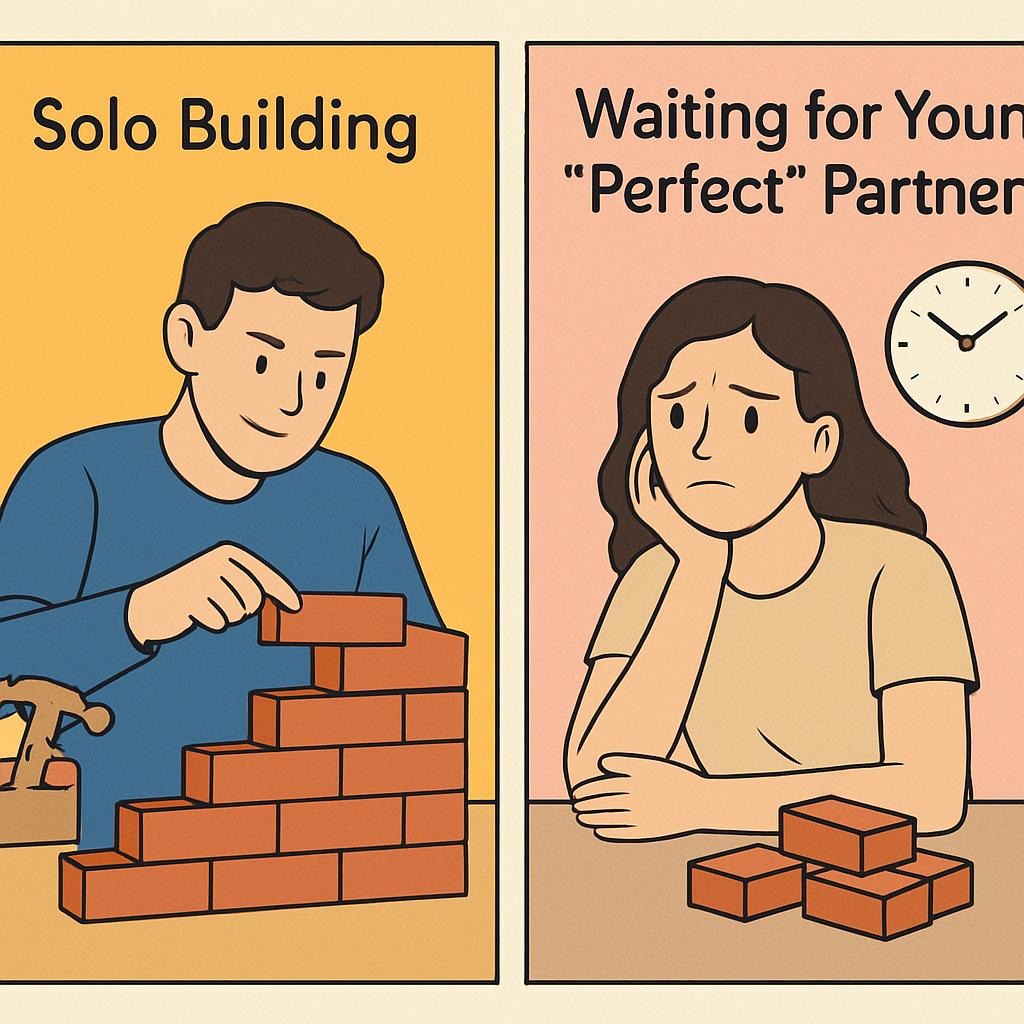
Start solo. Not as a default, but as a clarification tool. Give yourself 90 days of solo building. Not six months of planning for a perfect partner, but three months of actual work. Launch something small. Take clients. Create a course. Build a community. Do the real work.
During those 90 days, pay attention. Notice what’s actually hard and what you’re just afraid of. Notice what you wish someone else was doing and what you’re resisting doing yourself. Notice where you feel genuinely stuck and where you’re just procrastinating.
Stay open to partnership, but change the criteria. You’re no longer looking for someone to rescue you or complete you or keep you accountable. You’re looking for someone who sees what you’ve built, aligns with the vision, and has complementary expertise that actually accelerates the work.
This is a fundamentally different kind of partnership. It’s built on proven model, not hope. It’s built on mutual respect for what you’ve each created, not mutual desperation. And it tends to last longer and produce better results because both people chose to be there.
Structure projects with partnership as an option, not a requirement. This is the practical part.
If you’re building an online course, structure it so that you can eventually add a co-instructor without needing one to launch. If you’re building a community, set it up so you can invite community managers or facilitators as it grows. If you’re starting a coaching program, design it in modules so you could eventually partner with another coach.
The architecture should support solo launch and partnership evolution, not require partnership to begin.
How to Know Which Path Is Actually Yours
Here are some honest questions to discern whether you’re authentic about collaboration or using it as a delay tactic:
On Your History:
Have you actually built something solo before? If yes, what did you learn about yourself? If no, why are you assuming you know whether solo works for you?
On the Fear:
When you imagine starting alone, what’s the scary part? Is it that you don’t know how to do something, or is it that you’re afraid nobody will care? Those are different things.
On the Vision:
Can you clearly articulate what the business is before you add a partner to it? Or does your vision only come alive when you imagine someone else in the room? (One is healthy. The other is a red flag.)
On the Precedent:
Do you have examples of partnerships you’ve seen work? Or are you imagining what partnership could be without evidence of what it actually is?
On the Timeline:
How long are you willing to wait for the “right” partner? If the answer is indefinite, that’s procrastination language. If the answer is specific, that’s a real boundary.
The Reframe That Changes Everything
Here’s what I want you to understand: solo building and authentic collaboration aren’t opposites. They’re sequential.
You can be someone who genuinely thrives with partners and still start alone. The solo phase isn’t your identity; it’s your foundation. It’s where you figure out what you’re actually building, what you’re actually good at, and what you actually need.
And from that solid ground, if partnership is truly right for you, it will be so much more functional. So much more aligned. So much more powerful.
The entrepreneurs I know who have the healthiest partnerships are the ones who built something solo first. They know what they bring. They know what they’re protecting. They know what they can and can’t compromise on. And when they bring in a partner, it’s from a place of strength, not desperation.
The ones who are struggling in partnerships often got there through the waiting game. They were waiting for rescue. They were waiting for rescue. They were waiting for someone to complete them. And now they’re in business with someone they barely know, making decisions they’re unsure about, in a structure that was built on hope instead of evidence.
Don’t be that person.
Start solo. Not forever. Just long enough to know what you’re actually building. Then, if partnership is right for you, invite someone in with clarity and strength. Not because you need saving, but because you’ve built something worth building with someone.
That’s when real collaboration begins.
Leave a Reply