Every ambitious person eventually hits the same wall.
At 8am, you are sharp.
At 1pm, you are steady.
By 8pm, your standards collapse.
You said you would not drink tonight.
You said you would not scroll.
You said you would work on the sales page.
But your brain is tired. Your willpower is thin. And suddenly, the version of you who made promises this morning feels like a stranger.
This is not a character flaw.
It is biology.
And the most productive people in the world understand something most people never internalize:
They do not rely on discipline.
They build circumstances that make discipline unnecessary.
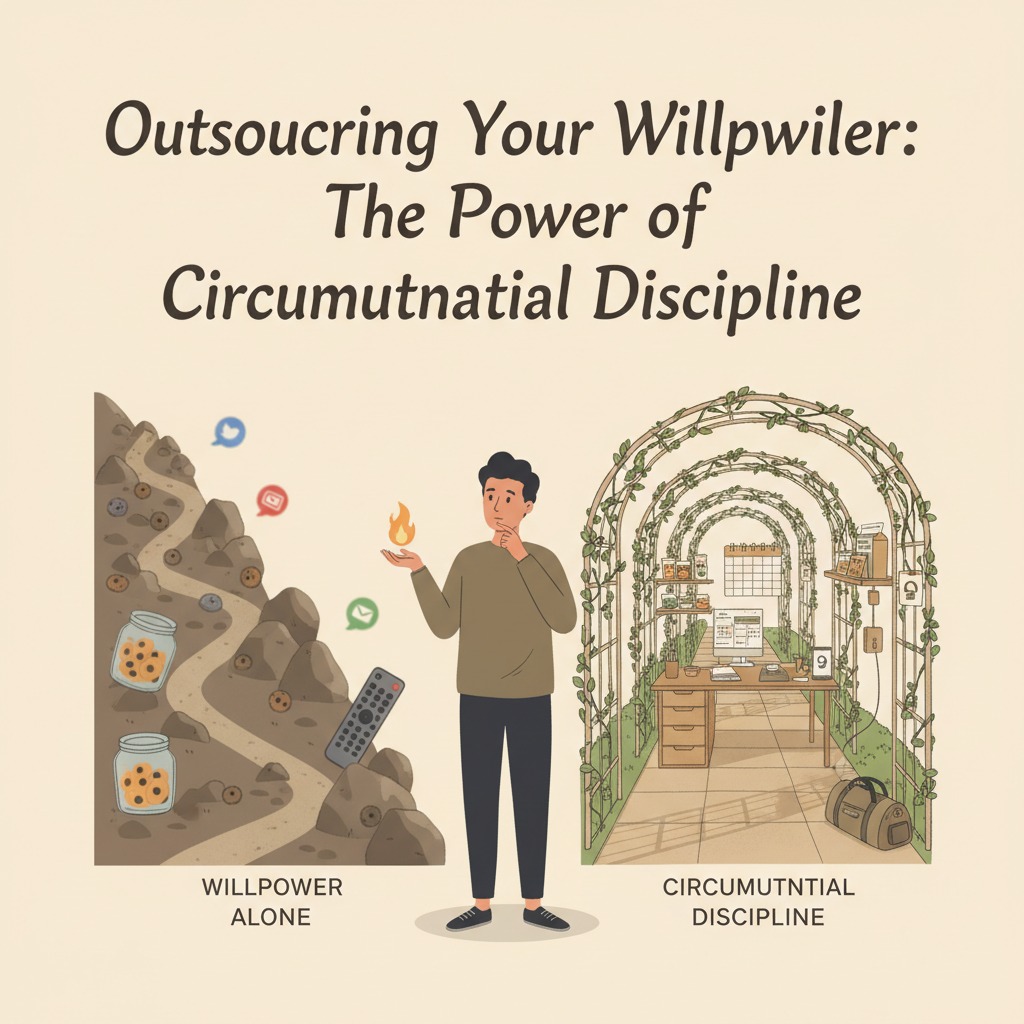
This is circumstantial discipline.
And it changes everything.
Why Willpower Always Fails Eventually
Let us start with reality.
Willpower is a limited resource.
Decision fatigue is real. Every choice you make throughout the day drains mental energy:
- What to wear
- What to eat
- Which email to answer
- Which client to prioritize
- Whether to respond to that text
- Whether to check social media
By evening, your brain wants relief.
Not growth.
Not excellence.
Relief.
And when relief competes with long term goals, relief usually wins.
This is why people break diets at night.
This is why entrepreneurs avoid outreach after 6pm.
This is why you “just check Instagram for five minutes” and lose an hour.
Willpower erodes.
Circumstances endure.
The Myth of the Ultra Disciplined Person
We love the narrative of the hyper disciplined founder.
Up at 5am.
Never misses a workout.
Never procrastinates.
Always focused.
But if you look closely, you will see something different.
They do not have superhuman willpower.
They have ruthless structure.
They remove temptation.
They pre commit.
They lock themselves into containers.
They outsource the burden of choice.
That is the difference.
Circumstantial Discipline Defined
Circumstantial discipline means designing your environment so the right action is easier than the wrong one.
It means:
- Blocking distracting websites before you feel tempted
- Booking a coach so skipping a workout costs you money
- Scheduling a coworking session so other humans are watching
- Putting your phone in another room before you start work
You are creating artificial constraints that protect your future self from your tired self.
This is not weakness.
It is strategy.
The 8 PM Version of You Cannot Be Trusted
The morning version of you is ambitious.
The late night version wants comfort.
If you are building a business, trying to get sober, trying to get fit, or trying to level up financially, you must accept this truth:
Your emotional state changes.
And if your system depends on you always feeling strong, you will lose.
So instead of asking:
“How can I be more disciplined?”
Ask:
“How can I make it hard to fail?”
That question shifts everything.
Tool 1: Website Blockers That Remove the Option
Distraction is frictionless.
Work requires activation energy.
So you must reverse that equation.
Website blockers like Freedom, Cold Turkey, or Opal allow you to pre block platforms during specific hours.
When set correctly:
- Instagram does not load
- YouTube does not open
- News sites are inaccessible
- Even certain apps can be locked
Now something important happens psychologically.
You are no longer negotiating.
There is no internal debate.
The option is gone.
When distraction is unavailable, your brain settles into work faster than you expect.
You have outsourced self control to software.
And that is powerful.
Tool 2: Paying for Accountability
Money creates seriousness.
If you have ever hired a fitness coach, you know this effect.
When you pay someone, you show up differently.
You do not want to waste the investment.
You do not want to disappoint them.
You do not want to look unserious.
This is why fitness coaches work.
This is why business coaches work.
This is why group programs work.
The environment shifts your identity.
You are no longer a lone operator hoping to be disciplined.
You are someone inside a structure.
If you are serious about growth, consider where you need pressure.
Where are you relying on “I should”?
Replace it with “I committed.”
Tool 3: Virtual Coworking and Forced Focus
One of the most underrated productivity hacks in the modern world is structured coworking.
Platforms like Flow Club create scheduled focus sessions where you log in, state your goal, and work silently alongside others.
It sounds simple.
But psychologically, it is potent.
Why?
Because:
- You declared your task publicly
- There is a start and end time
- Other people are present
- You feel observed, even virtually
That subtle social pressure changes behavior.
You are far less likely to open social media when someone just heard you say, “I am finishing my sales page.”
This is artificial circumstance at work.
You did not suddenly become more disciplined.
You placed yourself in a container where focus is the norm.
The Hidden Power of Pre Commitment
Pre commitment is one of the most powerful behavioral tools available.
It means deciding in advance what you will do, then locking in consequences or structures that make deviation harder.
Examples:
- Scheduling a post publicly so your audience expects it
- Telling a friend you will send them your completed draft by 6pm
- Booking a non refundable class
- Working from a library instead of your bed
Each of these removes wiggle room.
And wiggle room is where procrastination lives.
Designing a High Performance Environment
Let us get practical.
If you wanted to build circumstantial discipline around your main business goal, here is how you could approach it.
Step 1: Identify Your Weak Points
Be honest.
Do you:
- Scroll when anxious?
- Avoid outreach?
- Skip workouts when tired?
- Delay content creation?
Pinpoint the pattern.
You cannot engineer around a weakness you refuse to name.
Step 2: Remove Easy Escapes
If you scroll at night, delete the apps.
If you snack impulsively, do not keep junk food in your house.
If you procrastinate at home, work somewhere public.
Make the undesired behavior inconvenient.
Even small friction matters.
When something requires extra steps, your brain often abandons it.
Step 3: Add External Pressure
Pressure can be healthy when chosen intentionally.
Join a mastermind.
Hire a coach.
Book coworking blocks.
Schedule public deliverables.
You are not admitting weakness.
You are acknowledging human nature.
Even elite athletes have coaches.
Even top CEOs have boards.
Why would you expect to self regulate perfectly alone?
Step 4: Create a Default Work Container
Instead of asking daily, “Should I work now?”
Create fixed focus blocks.
For example:
9am to 11am is deep work.
Phone in another room.
Blockers on.
Door closed.
No decision required.
The container exists whether you feel inspired or not.
Over time, your brain associates that window with output.
You condition yourself.
Circumstantial Discipline and Sobriety
This concept is especially powerful if you are trying to reduce or eliminate alcohol.
Relying on willpower at night rarely works long term.
But circumstances can change everything.
Examples:
- Do not keep alcohol in the house
- Schedule evening workouts
- Attend group calls or meetings during trigger hours
- Replace bar environments with structured events
You are not constantly battling temptation.
You are redesigning your life so temptation shows up less frequently.
That is maturity.
The Identity Shift: From Hero to Architect
Most people try to be heroes.
They want to conquer urges through grit.
But grit alone is inefficient.
High performers think like architects.
They design systems.
They design schedules.
They design environments.
They understand that feelings fluctuate, but systems persist.
When you build circumstances that support your goals, you stop seeing productivity as a personality trait.
It becomes a byproduct of structure.
The Compounding Effect of Engineered Discipline
Imagine this scenario:
For the next 90 days:
- Social media is blocked during work hours
- You attend three virtual coworking sessions per week
- You have one accountability check in weekly
- Your phone never enters your workspace
Do you think your output would change?
Almost certainly.
And not because you became stronger.
Because you removed weak points.
Circumstances compound just like habits do.
You Do Not Rise to Goals, You Fall to Systems
You can set ambitious revenue targets.
You can write bold vision statements.
But when energy drops, you will default to your environment.
If your environment encourages distraction, you will drift.
If your environment encourages focus, you will produce.
This is why some people thrive in structured settings and flounder alone.
The difference is not intelligence.
It is containment.
A Simple Exercise to Start Tonight
Take ten minutes and redesign one area of your life.
Ask:
“What behavior keeps derailing me?”
Then ask:
“What circumstance could make that behavior harder or impossible?”
Examples:
- Use a blocker from 8am to 12pm daily
- Pre book four coworking sessions this week
- Move your phone charger outside the bedroom
- Set up a recurring meeting where you must present progress
Do not overcomplicate it.
Choose one structural change.
Implement it immediately.
Final Thought: Stop Testing Your Willpower
You do not need to prove how strong you are.
You need to win.
Testing your willpower daily is like playing a game with declining odds.
Eventually, you lose.
Instead, outsource the burden.
Let software block distractions.
Let money create accountability.
Let other humans create pressure.
Let your environment carry part of the load.
Circumstantial discipline is not about becoming rigid.
It is about becoming strategic.
When you build a life where the right action is the default, you stop waiting to feel motivated.
You simply show up inside the structure you designed.
And that is where real momentum begins.
Leave a Reply